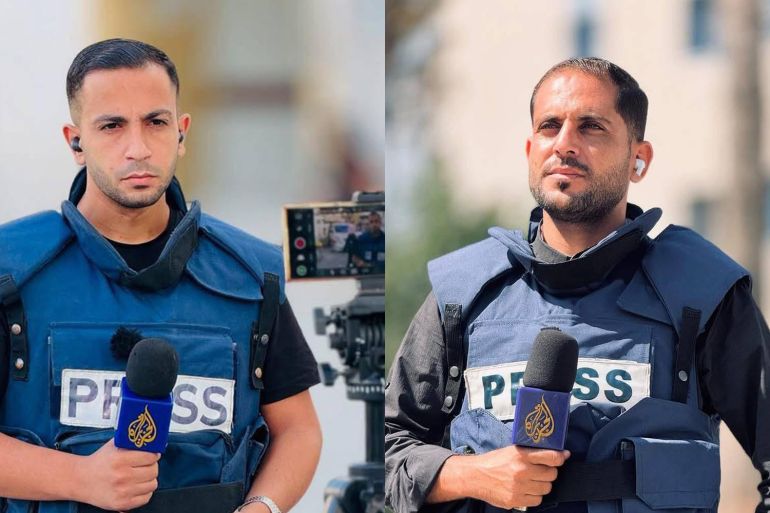
Remembering Anas, Mohammed and Gaza’s other slain journalists
Our colleagues in Gaza have taken the journalism profession to an unseen level. In doing so, they have paid the heaviest price.
Published On 10 Aug 202610 Aug 2026
Save

On the first death anniversary of our colleague Anas al-Sharif, we pray for mercy for him and for all our slain colleagues from Al Jazeera Media Network and the journalistic community in the Gaza Strip. On a day like this, we can only recall Anas’s courage, boldness and dedication to the profession, to his work and to his mission.
We recall his steadfastness and his ability to withstand pressure in the most difficult and harshest circumstances, and to continue carrying out his work without hesitation from northern Gaza until he was killed in the Israeli air strike that targeted Al Jazeera’s tent in front of al-Shifa Hospital.
The attack was extremely costly for Al Jazeera and for the journalistic community in the Strip, because it led to the killing of five other journalists, including the courteous, creative, calm and brilliant Al Jazeera correspondent Mohammed Qreiqeh; Al Jazeera cameramen Mohammed Noufal and Ibrahim Zaher; and two journalists who were near the tent, Moamen Aliwa and Mohammed al-Khalidi.
As we mark the first anniversary of their killings, we have to remember their deeds, virtues and qualities. We have to remember the extraordinary role they played alongside the rest of their colleagues in the Strip. We have to remember the new model they established in the world of journalism and media.
It is important to speak about this journalistic model they introduced, which was embodied in exceptional performance under exceptional circumstances. It redefined the concept of journalism and media in the modern era, and restored dignity to the profession and its noble humanitarian mission.
Advertisement
It is a model that emerged amid a genocidal war that was different from all those that preceded it in every respect. It began with the Israeli army closing the Gaza Strip, cutting off electricity and water completely, and halting the flow of food, medical treatment and humanitarian necessities for more than 2.4 million people, who were completely isolated from the world, besieged, and subjected to a barrage of bombs, rockets and shells. At the same time, Israeli forces prevented foreign journalists from reaching the Strip, which they continue to do to this day.
Journalists in the Strip were forced into displacement and homelessness along with the rest of Gaza’s residents. They had to flee their homes together with their families and they lost their offices, which were like second homes to them.
But the matter did not stop there. The occupation deliberately targeted the families of journalists, including my own family, which was displaced to a place we believed, according to what the Israeli army had announced, to be safe.
Then came the direct and deliberate attacks on journalists. They were targeted while working in the field, as happened with our colleague Ismail al-Ghoul; while they were in their work tents, as happened with Palestine Today journalist Ahmed Mansour, who was consumed by fire at night after his work shelter was hit; and even while they were in their homes, with their families, as happened to Mohammed Abu Hatab, correspondent for Palestine TV, only minutes after he had returned to his home in Khan Younis, leading to his killing along with 11 members of his family.
Hospitalised journalists were not spared from targeting either. Photojournalist Hassan Aslih, who was receiving treatment for a previous injury, was killed by Israeli shelling of Nasser Medical Complex in Khan Younis on May 13, 2025.
Just three months later, on August 25, Israel attacked the same hospital with a horrific double-tap strike, killing 22 people and injuring dozens. Among the victims were five journalists who worked with Al Jazeera and other international outlets: Mohammad Salama, Mariam Abu Daqqa, Hussam al-Masri, Moaz Abu Taha, and Ahmed Abu Aziz.
This was a clear and direct attack on journalists, as it first targeted a colleague setting up a Reuters camera on the roof of the hospital, which was routinely positioned there to broadcast live footage. When other journalists and paramedics rushed to the scene to evacuate the dead and wounded, they were taken by surprise by another attack.
Advertisement
Even reporting missions that had obtained prior approval from the Israeli army after coordination by the International Committee of the Red Cross were not spared from attacks. This happened to me and my colleague, veteran cameraman Samer Abudaqa. On December 15, 2023, we went to Khan Younis to report on an air strike on a school when we were attacked with an Israeli missile.
I was injured but survived. Samer was injured too but could not move. He bled for six hours while waiting for the Israeli army’s approval for ambulances to enter and save him. When they were finally allowed, they found the lifeless bodies of Samer and three Palestinian Civil Defence paramedics who had been accompanying us on that mission.
These attacks strengthened our conviction as journalists that the vests, helmets and press insignia we wear while doing our work have turned us into targets for Israeli forces’ aircraft, tanks and snipers, instead of serving as protection.
It was truly deplorable that the world and its international institutions remained silent in the face of these war crimes. That silence was no less painful for us than the pain of the targeting itself.
Even when some statements and condemnations began to be issued by certain parties, they were not commensurate with these crimes; they were not enough to pressure Israel to change its policy of targeting journalists. Rather, they signalled impunity and encouraged it to continue these crimes. To date, Israel has killed some 265 journalists. The number of casualties of its genocide has reached a quarter of a million people.
This has raised many questions. How can journalists continue their work and convey people’s reality amid genocide, while being unable to speak about their own suffering? How can they bid farewell every day to colleagues and then continue their mission, knowing that they themselves could soon be carried to the graveyard?
Certainly, these are difficult questions. The true answers will only be known by those who lived through this experience, were burned by its fire, and paid a heavy price. This is an experience that cameras and words fail to document. But it is, in any case, an experience that deserves to be spoken about.
First, because it needs to be preserved from oblivion and loss as an exceptional professional experience.
Second, because sharing it may make it a source of inspiration for our colleagues around the world, especially those newly joining the ranks of this profession.
In answering these questions, it goes without saying that the successive events and wars in the Strip over the past quarter-century have produced large numbers of journalists within the Strip with seasoned and intensive experience, very high professional qualities, and an unbelievable ability to work under pressure as a result of that long and intense experience.
But what is most important, in my view, is that they helped produce a generation of journalists who believed in the importance of the arduous, exhausting, and dangerous work they do — not merely as a job, but as a humanitarian profession, a noble mission, and indeed a moral and national duty to convey human issues, human concerns, and the unbelievable injustice to which human beings are subjected in this part of the world.
Advertisement
Moreover, the journalists, their families, their homes, their offices, their past, present and future, their memories, and everything that ties them to this place have become exposed to the same injustice and the same threat in an unprecedented way. This has added a new conviction to their belief in the importance of what they do and has made them live through a unique psychological state.
It is a state in which the concepts of death and life no longer differ much, because the journalist, like everyone else, has come to feel unsafe — whether for himself, his family, his colleagues, or his profession — and has become haunted by the notion that he is closer to death than to life. And if a person is convinced that he will inevitably die, he will spend his final moments doing the work he loves and believes in, embracing its professionalism, its humanity, its importance, its impact and its value.
Now, after three years of ongoing genocide in different forms, colours and degrees, imagine with me if this role, this effort, and these sacrifices had not existed in the face of this genocide. Imagine what the genocide would have looked like, its scale and its limits, including the crimes against the journalists themselves. And imagine what the world would look like today if it had not heard the details of this genocide.
It is true that the price has been steep — unprecedentedly steep — but at least it was not paid in vain. What was done in vain are Israel’s relentless attempts, and those of its army, to kill the truth in its cradle by killing the messengers and soldiers of truth and by isolating the Strip from the outside world.
Israel not only failed to achieve this; its atrocious efforts at silencing Gaza’s journalists have made the world — or at least a large part of it — realise one truth: that what is happening is a crime against humanity and a genocide being inflicted on a besieged people.
The journalists who remain alive continued to carry out the mission tirelessly, and with a level of professionalism and competence rarely seen. What remains most important from our perspective as journalists and as victims at this stage is to stop these crimes, this genocide.
And stopping it can only be achieved by holding the perpetrators accountable and punishing them so that they do not continue committing more crimes, and so that we do not encourage new criminals to commit new crimes in new places.
The absence of accountability and punishment means that Anas, Mohammed, Ismail, Samer, my son Hamza, and all our colleagues will not rest in their graves. The world has participated in killing them twice: once through silence over the crime, and again through silence over the lack of accountability for the criminal.