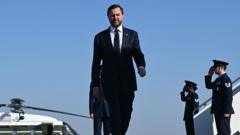
It was an early sign that Trump – who has prized loyalty from his advisers – may give Vance a wide berth should he choose to launch a presidential campaign.
“I know how he feels about it. I think it was — I think it was fine,” Trump told reporters when asked about Vance’s post blaming the war. “I knew that when I went in, and we stopped them from having a nuclear weapon, and they will never have a nuclear weapon.”
Vance’s statement seemed like “a way of separating himself from Trump,” said Daniel Byman, a foreign policy expert at the Center for Strategic and International Studies.
Drawing contrasts with Trump will be a delicate balancing act if Vance seeks the presidency, Byman added.
That balance was on display in Vance’s post. The vice president didn’t mention Trump by name and attributed much of his election results analysis to unnamed pollsters.
Vance “put his toe in the water to see what he’s going to do,” Ashley Davis, a Republican strategist, told the BBC.
Beyond the Iran war criticism, Vance also offered a political roadmap that could preview a possible presidential campaign. He distilled the party’s strategy to win back voters into a neat four-point gameplan: “1) End the war 2) Focus on cost of living/inflation 3) Put America First 4) Change our relationship to Israel.”
The list encapsulated much of Vance’s worldview since bursting onto the national political scene, and read like the core argument in a future stump speech.
The BBC has contacted Vance’s office for comment.