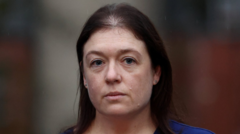
Her calls echo those made by her mother, who spoke on the steps of Winchester Crown Court after the trial.
“No-one should be able to give it [consent] on your behalf,” said Joanne Young, who has waived her right to anonymity.
“I urge the government to look at this as a priority so that women are properly protected in future.”
The Sexual Offences Act 2003 states that “a person consents if he agrees by choice, and has the freedom and capacity to make that choice”.
“If someone is drugged asleep and unconscious they can’t give consent,” Professor Miranda Horvath, director of the University of Suffolk’s Institute for Social Justice and Crime, told the BBC.
“Someone can’t give consent on your behalf.
“[Technology] is quickly evolving but we need to look at where improvements can be made in the legislation.”
Like Joanne Young, Laura Bishop from Bristol has also waived her right to anonymity after her ex-husband received a 14-year prison sentence for drugging and raping her while inviting other men to abuse her.
Speaking to BBC Radio 4’s Today Programme, Bishop said the crimes will affect her for the rest of her life.
“It’s something that unfortunately you can never get over,” she said.
“You have to try and remain positive and optimistic but the betrayal, particularly by men, is very difficult to move on from.”
Bishop has a PhD in cyber crime and uses her expertise and experience to work with MPs and charities to improve governance around digital safety and regulations.
“The sites my husband used to advertise me are still active and are known by the police to not provide evidence and forensics when asked.
“So why are they still accessible?” she said.