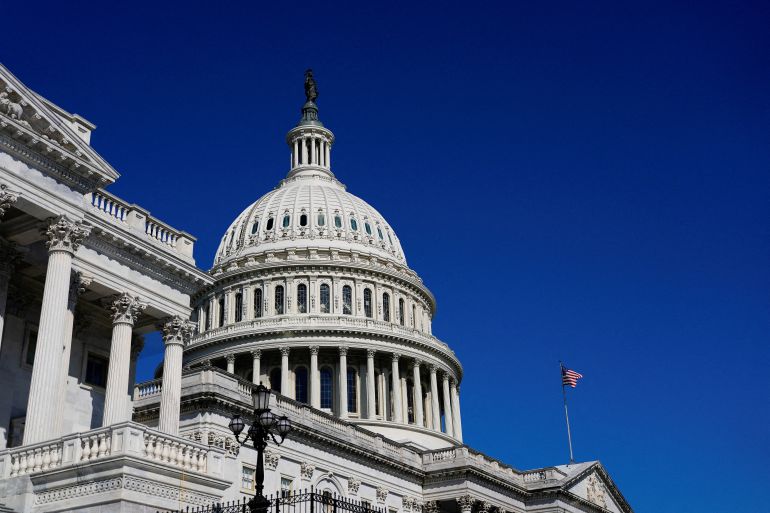
What could Democrats do with their expanding congressional majority?
The Democratic Party is debating how best to use its large margin of victory in the US midterm elections.


24 Nov 2026
The Democratic Party has continued to expand its already sizeable majorities in the United States Congress as counting concludes in the final races of the 2026 midterm elections.
As of Monday, the Democrats hold a 258-seat majority in the 435-member House of Representatives. Four races remain uncalled.
end of list
All the races have been decided, meanwhile, for the Senate, where Democrats gained a 56-seat majority out of 100 total seats.
Flipping both chambers gives the party a strong hand to shape legislation during the last two years of Trump’s term in office.
How might the Democrats approach their role in government once the new Congress is sworn in on January 3? Find out in this quick explainer.
What do the results say?
The midterm results give Democrats their largest House majority since 1992 and their largest Senate majority in more than a decade. Republicans, meanwhile, saw their tally in the House drop to 173 seats, their lowest figure in years.
The vote also served as a firm rebuke of Trump’s second term as president, with voters venting their frustration over cost-of-living issues, the US-Israel war on Iran, aggressive immigration raids and corruption.
Democratic victories also extended well beyond traditional left-wing strongholds, with candidates racking up wins in Republican-led states such as Texas, Mississippi and South Carolina.
Which races remain?
Four House seats have yet to be called: one in Minnesota, one in Tennessee, and two in Louisiana that will be settled by a run-off on December 12.
Those races could see the Democrats further expand their majority in the House. The final count is now a question of just how large the party’s majority will be.
What will Democrats do with their majority?
Democrats have long pledged to use any congressional majorities they win as a check on Trump’s agenda.
But the scale of their success in the 2026 midterms has prompted discussion about embracing a more ambitious legislative agenda.
In the House of Representatives, Democrats have outlined a 100-day agenda that includes potentially reversing tax cuts that largely benefit wealthy earners and restoring healthcare subsidies that expired under Trump.
Lawmakers have also said that they will act to end the war on Iran, although divisions remain within the party over how to rein in Trump’s military actions. Under the US Constitution, Congress alone can authorise military operations.
Progressives have accused the party’s moderate wing of playing down expectations of firm steps to end the war, including cutting off funding.
Democrats have also pledged to use their newfound position to exercise oversight over the executive branch by launching probes and issuing subpoenas.
On Monday, for example, House Speaker-designate Hakeem Jeffries said that a Democrat-led Congress would conduct a “swift, thorough, and wide-ranging” investigation into the actions of the chip manufacturer Nvidia.
He also said it would delve into the “corrupt abuse of power” by Commerce Secretary Howard Lutnick.
In the Senate, Democrats have also threatened to block Trump’s nominees for high-level government positions, which require the chamber’s confirmation.
What role will Trump play?
While Democrats will hold substantial majorities in both chambers of Congress, Trump will retain the power to veto legislation.
Some lawmakers, however, have tried to persuade the president that he could benefit from working with Democrats after his party’s stark defeat in the midterms.
Senator-elect Abdul El-Sayed, for example, has shared a series of tongue-in-cheek social media posts suggesting that a universal healthcare programme — a long-term progressive goal — could be named after the president in a bid to win his support.
“Donald, this is on the table,” El-Sayed said in a social media post showing a card for a hypothetical health insurance programme titled “Trumpcare”. “Guarantee healthcare for every American, from cradle to grave.”
Could Trump work with the Democrats?
There is little evidence, however, to suggest that Trump is planning a political pivot after the midterms.
Within a week of the vote, for instance, Trump named Stephen Miller — one of the architects of his hardline policies on immigration — as White House chief of staff.
The staffing shake-up was seen as a doubling-down on right-wing policy priorities.
While Trump has, at times, suggested that he could cooperate with Democratic lawmakers, he has also promised to use his veto power aggressively.
He has also taken to social media to disparage Chuck Schumer, who is currently seeking to become the next Senate majority leader, a position he previously held from 2021 to 2025.
“It is going to be very hard for me to work with Chuck Schumer should he become Senate Majority Leader,” Trump said in a Truth Social post on Sunday.
“He failed badly as ‘Leader’ once before, one of the worst in history, and I have little doubt that he will fail again.”
Trump’s White House has also threatened to take action if Democrats aggressively use their oversight powers in Congress.
“Members of the new Congress have evinced a clear intent to transgress” the constitutional limits of their power, White House counsel Will Scharf wrote in a letter on November 9, gesturing to the prospect of congressional investigations.