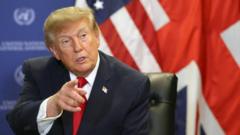
US President Donald Trump has said Andy Burnham is a man he can do business with, after the two leaders met in person for the first time.
Trump said UK-US relations are “more up now” that Burnham is in power, following their meeting on the sidelines of the UN General Assembly in New York.
Speaking to reporters, Burnham said he had “established a good connection” with Trump and they had “taken that further today” following discussions on issues such as trade and immigration.
But the US president made clear his opposition to the UK’s “terrible” deal to hand over the Chagos Islands to Mauritius and pay to lease back a joint UK-US military base on the archipelago’s largest island, Diego Garcia.
Burnham, asked by broadcasters if the deal is “dead”, later said the UK will “work hard” to find a resolution between the different sides and he is “confident we can find it working with our US partners”.
Trump and Burnham met on Tuesday as they attended the United Nations for the annual gathering of world leaders.
Following bilateral talks, Burnham sat alongside Trump and used his opening remarks to say: “You and I have established a good connection in our early discussions and we’ve taken that further today.”
The two men then faced questions shouted from the assembled press pack.
Asked by the BBC if Burnham was a man he could do business with, Trump said: “Yeah I do, I think he’s a natural businessperson, we’ve had a lot of discussions even before this meeting we’ve spoken to each other numerous times on the phone.
“Yeah, I think so, he gets it, he understands what he has to do.”
Burnham later said he had explained to Trump that Britain has been in “too much turbulence” in recent times but it is time to “turn the story” about the country into a positive one.
The US president added that the UK is a country with “great patriotism”, and he thinks it is “waiting for good leadership, waiting for success”.
Relations between Sir Keir and Trump also began well before becoming increasingly strained earlier this year when the then-prime minister refused to permit the use of UK bases for the initial US-Israel strikes on Iran.