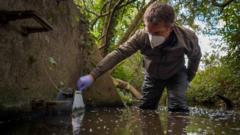
We also wanted to know whether analysing the E. coli samples from the bathing site could give us clues to where it came from.
With assistance from researchers at the University of Bristol, Morley arranged for e-DNA analysis to be carried out to identify whether the E. coli bacteria were more likely to be from a human or animal gut.
The answer, as is often the case with water quality, is complex. There were lots of different types of E.coli in the samples.
“Some were from humans, some were from animals and some were just generic from the environment,” Morley says. “It definitely suggests that some of the E. coli is definitely coming from human origins, therefore potentially from that treatment works.”
As with all of our testing, more needs to be done to reach firm conclusions.
Both the EA and Wessex Water are investigating what’s causing the water quality in Taunton to be so poor. But sources at the EA told the BBC that constant flows of treated effluent is high up the list of likely culprits.
In response to our testing Wessex Water told the BBC its treatment works at Bradford on Tone was working normally and was meeting all its permit conditions set by the EA.
So could steady flows of treated effluent loaded with bacteria be behind many of the problems at bathing sites across the UK?
“All the sewage treatment works in the UK and in England have permits to protect the ecology and the wildlife within the river,” says Jim Flory, a regional manager for the EA in the south-west.
“They’ve not set permits for bathing water regulations, which are all about protecting people who may want to be swimming, canoeing or using the water.”
That has led to a system where a popular bathing site gets officially designated – the testing regime discovers it has high levels of faecal bacteria – and then a lengthy process begins to try to work out where the sources are and whether it’s affordable to fix them.