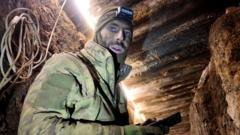
The cart continues its journey into the bowels of the earth. It returns about half an hour later with more troops covered in dirt. They have been fighting in positions on the surface.
There is a look of relief on their dust-caked faces.
“It’s more comfortable in the pipe because drones don’t fly here, and neither do artillery shells or glide bombs,” says Vovochka, who has been fighting on the ground for the past three weeks.
But there has been fighting in the pipeline, too. Operation Veles, named after a mythical Slavic god of the underworld, began in April. Since then Ukraine has advanced 15km (9.3 miles) along the pipeline.
It has been painstaking, backbreaking work – with the ever-present fear of coming into contact with the enemy.
Back above ground we meet a few of the soldiers, from the 13th Khartiia Brigade of Ukraine’s National Guard, who have taken part in the mission. Their first task was to clear the detritus, water and Russian barricades inside the pipeline.
The Ukrainian troops say some of the barriers were boobytrapped or piled with Russian bodies. “When we moved them or climbed over them, we had no idea what was underneath,” says Chyzh.
The other danger, he said, was the ricochets from gunfire when they tried to advance. “You never know where a bullet is going to go or how it will bounce.”
His comrade Kort says “we were all firing, we were pushing them back”. Over the course of the operation Ukraine says it killed more than 100 Russian soldiers and took 30 prisoners. “Yes, there were bodies,” says Kort. “I even had to sleep right next to them.”