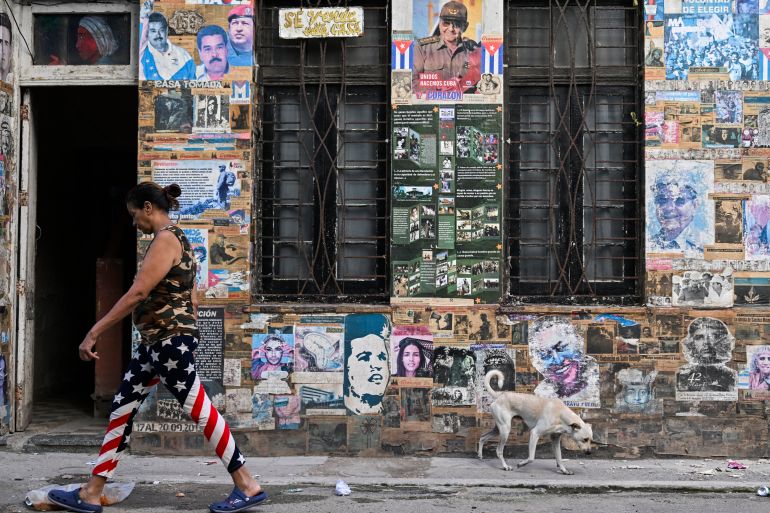
‘Homeland or death’: How Cuba would defend itself against a US attack
With Castro indicted, a US military operation in Cuba could be imminent, but Havana is not entirely defenceless, some analysts argue.
Save

 By Urooba JamalPublished On 21 May 202621 May 2026
Helen Yaffe, in her frequent, regular trips to Cuba for the last 30 years, remembers once when a Category Four hurricane barrelled its way to the island.
The academic and podcaster was then living in a house with 13 other people, and when the storm hit, there was no panic – everyone already knew their role.
Recommended Stories
list of 4 itemsend of list
Some escorted elderly and vulnerable neighbours to shelters. Others prepared to clear debris once the winds subsided.
Cuba’s system of national defence against such meteorological disasters has been lauded by the United Nations and the World Health Organization for minimising casualties despite frequent extreme weather.
Now, Havana is seeking to apply a similar model to a different threat: a possible United States military confrontation, as President Donald Trump’s rhetoric towards Cuba intensified on Wednesday, with US federal prosecutors indicting former Cuban President Raul Castro in the sharpest escalation between the two countries in years.
The indictment dates back to a 1996 incident in which four American men died when Cuban jets allegedly shot down aircraft operated by Cuban exiles. It charges Castro with conspiracy to kill US nationals, four counts of murder and two counts of aircraft destruction.
Amid the tensions, on Saturday, Cuba’s Civil Defence released a multi-page guide titled The Family Guide for Protection Against Military Aggression, listing the responsibilities of families in the case of a US attack, as well as numerous safety protocols.
The guide builds from Cuba’s defence doctrine, named War of All People, which it adopted after the fall of the Soviet Union, and envisions resisting foreign invasion by mobilising the entire civilian population through guerrilla warfare, local militias and civil defence networks, said Yaffe.
Advertisement
“Everyone in Cuba is trained militarily and … incorporated into this system of national defence,” Yaffe, a professor of Latin American political economy at the University of Glasgow, and host of the podcast titled Cuba Analysis, told Al Jazeera.
Castro’s indictment marks the latest escalation in a mounting pressure campaign that has included a surge in US surveillance flights off Cuba’s coast in recent months, a narrowly defeated US Senate move to block efforts to limit Trump’s authority to use military force against the island, and executive orders declaring Cuba a “significant threat” to US national security.
And Trump has stated, plainly, that “Cuba is next”. A US military operation, therefore, could be imminent, analysts have said.
While opinions diverge, some analysts said Cuba is not entirely defenceless despite being in the grips of blackouts, fuel shortages caused by a US oil blockade, and the loss of Venezuelan energy supplies following Nicolas Maduro’s abduction and ouster from Caracas.
The Venezuela model ‘won’t work in Cuba’
When US forces abducted Maduro on January 3, the operation’s speed stunned the world. But 32 of those killed in the fighting were Cuban – troops who put up “a really fierce resistance”, said Yaffe.
Trump himself even acknowledged it, she said.
For his part, Cuban President Miguel Diaz-Canel said on Monday that any US military action against Cuba would lead to a “bloodbath” and that the island does not represent a threat.
“They talk about the Venezuelan model, and the question was, would they go for the Venezuelan model in Cuba? It won’t work in Cuba,” said Yaffe.
“The narrative from the Cuban leaders, and actually the Cuban people, has been: ‘They think that was a fierce resistance? That was 32 Cubans. Imagine if they come here, [there] will be 10 million.’”
Carlos Malamud, an Argentinian Latin America analyst at the Elcano Royal Institute in Madrid, Spain, agrees that Cuba presents a fundamentally different challenge than Venezuela.
The Cuban military, he said, is better trained and better equipped than its Venezuelan counterpart.
Sebastian Arcos, the Cuban-American director at Florida International University’s Institute for Cuban Studies, however, had a sharply different take on Havana’s armed forces.
“Cuba’s military is obsolete. They have little chance of resisting the US,” he told Al Jazeera.
“Cuba is a harder target [than Venezuela], not so much militarily, but because they have had time to prepare for a similar operation.”
Advertisement
But another key variable is geography, the analysts agreed.
The proximity of Cuba to the US means that Cuba’s “capacity of response”, including its air force, is far greater than anything the US faced in Caracas or in Iran — where the US and Israel have waged a war against Tehran since February 28, though a fragile ceasefire is in place — said Malamud.
Any attack on Cuba, he said, carries with it the very real possibility of Cuban retaliation reaching American cities.
“The capacity to provoke losses in the civilian population, and in the American cities, like Miami, for example, is higher,” he said.
Arcos said Cuba could attack US civilian centres to try to turn US public opinion against the Trump administration.
On Sunday, US outlet Axios published a report – citing unverified US intelligence – that Cuba had acquired 300 military drones, with plans to strike Guantanamo Bay, US naval vessels, and the US island city of Key West.
But Yaffe and Malamud were sceptical of the intelligence, remarking that Cuba is not seeking a military confrontation. Arcos, however, said the Axios report “makes sense”, as Cuba has always maintained close ties to Russia and China, prioritising security even amid scarce resources.
Cuba, meanwhile, had slammed the report as aimed at building justification for a US attack, and also stated that it has a right to self-defence against any US aggression.
Differing domestic constraints
Beyond the military calculus, analysts point to a set of political constraints that make a US invasion of Cuba far more complicated than the Venezuela operation, and potentially fatal to Trump’s domestic standing.
A migration surge to the US as a fallout of any attack on the island is chief among them, said Yaffe.
“Any attack on Cuba would spark an immediate, uncontrollable mass migration, mainly through the sea,” Yaffe said.
For a president whose political identity is built on anti-immigration, she argued, that consequence alone should give Washington pause, especially with midterm elections approaching in November.
Meanwhile, Cuban Americans – many who are against the Cuban government and its system of socialism – have considerably more representation in American politics when compared with the Venezuelan diaspora, said Malamud.
There is “no comparison”, in fact, he said.
Venezuelan exiles – many who were opposed to Maduro’s government and his socialist predecessor Hugo Chavez – have largely only been in the US for the last decade, Malamud noted.
Cuban Americans have been a political constituency for decades, with significant representation in Congress, and in the Trump administration itself, including with Marco Rubio as the current secretary of state.
That community, he argued, would never accept a Venezuela-style resolution – one that preserved the existing power structure under new management, as former Venezuelan Vice President Delcy Rodriguez’s assumption of power in Caracas did.
For Cuban exiles, anything short of regime change away from the Castro-era system is “inadmissible”, said Malamud.
Advertisement
Yaffe noted that there appears to be a difference of opinion even between Rubio and Trump.
While Rubio has “monopolised Trump’s ear on Cuba”, Trump is more deal-oriented – and has a long personal history of interest in Cuban business opportunities, she said.
Additionally, Trump has said that “they can’t move on to Cuba” until they’ve finished dealing with the Iran war, a prospect that continues to slip away, said Yaffe.
A Maduro-style abduction of Castro following his indictment, therefore, would satisfy neither the Cuban-American base nor achieve any strategic result, she argued.
Revolutionary honour in Cuba, Yaffe explained, is attached to martyrdom. The country’s official motto is “Patria o muerte, venceremos”, she said, which translates to “Homeland or death, we will prevail”.
“I cannot see the abduction of Raul (Castro) in any way pressuring the government to make concessions,” said the professor.
Arcos, meanwhile, predicted a military operation “halfway between Venezuela and Iran, with aerial strikes and no boots on the ground”.
Defence in times of a crippling economic crisis
Matias Brum, an assistant professor of economics at Universidad ORT Uruguay, cautioned that whatever happens next in Cuba – as it deals with an economic crisis accelerated by the loss of Venezuelan oil following Maduro’s abduction – would represent a stark warning for the region.
“I was under the impression that the United States was never going to invade and was never going to do anything, but they invaded and they kidnapped Maduro,” Brum told Al Jazeera.
“I would take him [Trump] seriously right now. I was not taking him seriously before, but now I am scared.”
Left-leaning countries in the region will likely be watching for any potential moves against Cuba, especially countries like Colombia and Mexico, which Trump has also threatened to invade, he added.
Seizing on Cuba’s burgeoning crisis, Rubio earlier on Wednesday offered to forge a new relationship between the two countries, offering $100m in food and medicine to Havana, building on Trump’s earlier offer that President Diaz-Canel had said he was open to.
But the US secretary of state did not acknowledge that the country’s economic crisis was in good measure a result of the decades-long US blockade on the country, blaming Cuba’s leadership instead for the shortages of electricity, food and fuel.
Arcos, in line with Rubio’s position, said Cuba’s crisis began 30 years ago with the collapse of the Soviet Union, and that the government’s “intransigence is responsible for the economic collapse” – and not US sanctions or the blockade.
Regardless of how the crisis is interpreted, Malamud, however, said that Cuba retains some advantages in deterring a US attack compared with Venezuela, though its deepening humanitarian crisis could ultimately hamper its ability to do so.
“That is the key element, the difficulty of the Cuban situation, because the dimension of the crisis … is absolutely a very terminal situation.”
Against this backdrop, as the decades-old tension between the US and Cuba builds to a crescendo, only time will tell whether Cuba’s War of All People remains a doctrine or a reality.
In Havana, at least, one slogan has been echoing across the island as the pressure mounts, said Yaffe: “Aqui no se rinde nadie – no one surrenders here.”